Naked pairs, hidden pairs: the two techniques every solver should master
Naked and hidden pairs eliminate candidates without needing a single placement. Master them once and every sudoku — classic or killer — gets noticeably faster.
Most sudoku tutorials teach naked singles (one candidate left in a cell) and hidden singles (one cell left for a candidate in a unit). Those will solve every easy puzzle. The minute you hit medium, you need two more tools: naked pairs and hidden pairs.
These two techniques are eliminations, not placements. You don’t fill any cells with them directly. Instead, you rule out candidates elsewhere — and those eliminations cascade into placements.
Naked pair
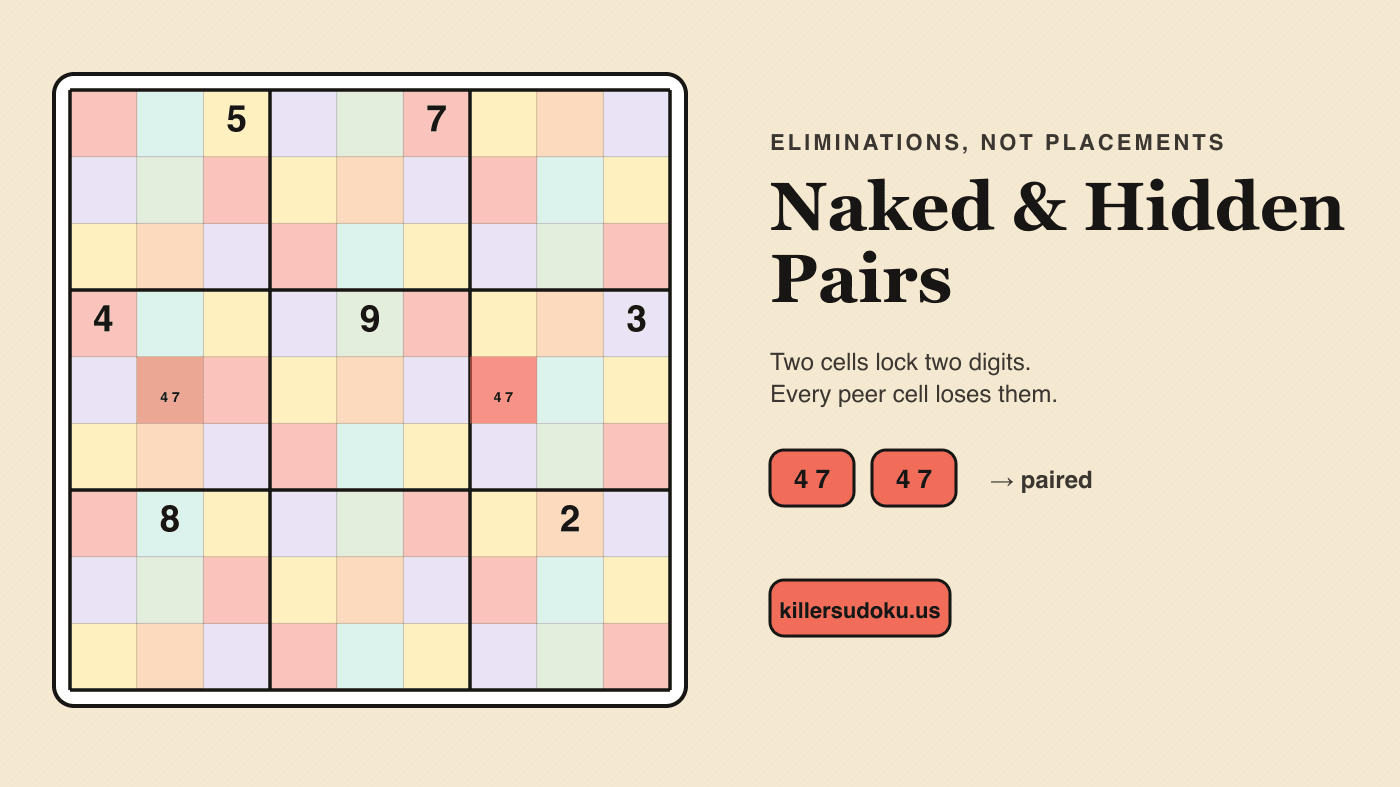
A naked pair is two cells in the same row, column, or 3×3 box whose pencil marks have been reduced to the same two candidates.
If those two cells contain only {4, 7} as candidates, you don’t know which is the 4 and which is the 7 yet — but you do know that between them, they will use up the 4 and the 7 in that unit. So no other cell in the same unit can be a 4 or a 7.
Find a naked pair and you can scrub those two digits from every other cell in the unit. That often clears the way for a hidden single elsewhere.
Hidden pair
Hidden pairs are the same idea, run in reverse.
A hidden pair is when two specific digits can only appear in two specific cells within a unit — but those cells also have other candidates clouding the picture.
Example: in row 3, the digit 5 can only go in cells C3 or G3. The digit 8 can also only go in cells C3 or G3. The other cells in row 3 each have their own candidates, but 5 and 8 are pinned to those two.
Even though C3 might currently show pencil marks like {2, 5, 8, 9} and G3 might show {1, 5, 6, 8}, you can erase the extras. Both cells must end up as either a 5 or an 8 (since those two digits have nowhere else to go in the row). So C3 = {5, 8} and G3 = {5, 8}. You’ve just created a naked pair from a hidden pair.
Hidden pairs are harder to spot than naked pairs because the candidates are buried among other digits. The trick is to scan one digit at a time across a unit: where can the 5 go in this row? If the answer is only two cells, check the next digit. If another digit also pins to those same two cells, you have a hidden pair.
Why these two matter more than naked triples, X-wings, etc.
Naked and hidden pairs appear in roughly 80% of medium and hard puzzles. The fancier techniques you’ll read about — naked triples, X-wings, swordfish, coloring — exist for the puzzles where pairs alone don’t crack the puzzle. Most of the time, pairs are enough.
The other reason: pairs are fast. Once you know what you’re looking for, you can scan a row in 3–4 seconds. A swordfish takes 30 seconds even when you find one.
Build the habit:
- Mark all candidates before you start looking for pairs (use the Notes mode in our puzzle — keyboard shortcut N).
- Walk the rows, columns, and boxes one at a time.
- For each unit, ask: Are any two cells identical to a 2-candidate set? (naked pair).
- Then ask: Are any two digits only present in the same two cells? (hidden pair).
- When you find one, apply the elimination and move on. Don’t try to solve a chain immediately — let the next pass pick up the cascade.
Pairs in killer sudoku specifically
Killer adds cage constraints, which interact beautifully with pairs.
If you’ve worked out that a 3-cell cage worth 6 must contain {1, 2, 3} (from the cage combinations cheat sheet), and two of those three cells share a row, the third cell pins down — and the {1, 2, 3} effectively act as a naked triple for the other six cells of that row.
Combining cage combinations + naked pairs is where killer sudoku stops feeling random and starts feeling like a logic puzzle that you can grind through deterministically. Which it is.
Try what you just learned